How I Fixed My Job Search After 300+ Applications (Part 1)
A job search guide from 300+ applications: find fresh jobs on Google and LinkedIn, filter smarter, tailor your resume, and get referrals that actually work.
By Saksham Malhotra · · 17 min read
- job search
- networking
- referrals
- resume
- career
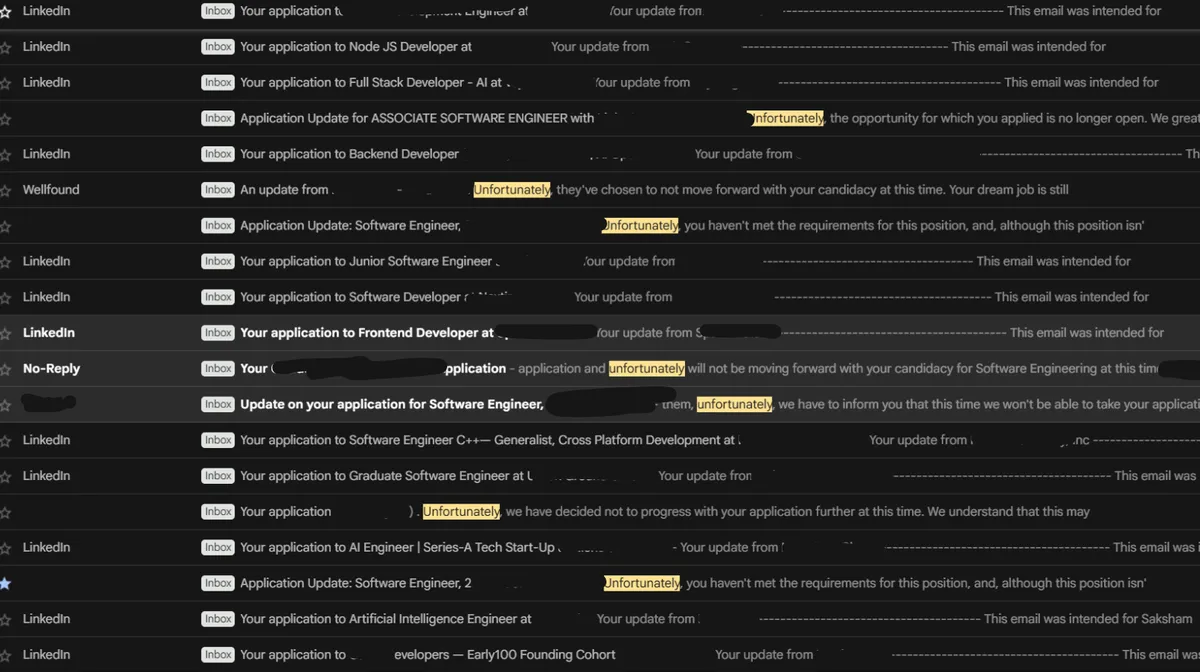
I applied to 300+ jobs. And I lost basically all of them.
Not because my resume was empty. I had Amazon on it. Adobe on it. Real software engineering work, projects, a decent technical background. On paper I was fine.
The applications still weren’t turning into interviews.
At some point it clicked: the fix wasn’t “apply to 1,000 jobs instead of 300.” The fix was admitting that the way I was finding and applying to jobs was broken. So I started changing the process. I stole ideas from LinkedIn posts, watched how other people were doing it, tried a bunch of things, and the results changed a lot.
This is Part 1: everything I changed, in the order I’d do it again. In Part 2, I’ll go deeper on remote jobs and how to actually crack networking.
TL;DR
- Get picky. Apply to roles you can actually land. A few moonshots are fine, a whole job search of them isn’t.
- Look in two places. Google
site:searches straight on career pages (Workday, Ashby and the rest), plus a LinkedIn feed you’ve trained to show you hiring posts. - Filter hard. Posted in the last 30 minutes, under 50 applicants, a company you’ve actually checked. Easy apply portal with no captcha? Assume 1,000+ applicants and skip it.
- One resume per job title. Tailor it with AI, but only for the jobs that make it through the filter.
- AI is your assistant, not your autopilot. Hiring is still human first.
- Network with the actual team. For referrals, go for people who don’t post every day. Follow up after a day.
- Post and comment like a real person. That’s networking too.
- Keep going. It’s going to suck sometimes. That’s part of it.
Stop treating every opening as your opportunity
The biggest change: I got picky.
You don’t need to apply to every job you see. There are enough roles out there where your profile genuinely makes sense. The goal is simple:
Apply to jobs you can realistically get, not just jobs you wish you could get.
Shooting your shot is fine. Maybe 1, 2, even 3 out of every 10 applications are moonshots. Cool. But if your whole job search is moonshots, you’re going to be cooked.
Before applying, I ask:
- Does my experience match?
- Does my seniority match?
- Does the location work?
- Is this a role where this company could actually hire me?
You don’t need to tick every box. But there’s a big difference between “I’m missing one of their preferred requirements” and “I don’t match what this role is fundamentally about.” Don’t spend most of your applications on the second kind.
How to find jobs outside LinkedIn’s job feed
This one changed a lot for me. I started using Google to find jobs. That way you’re searching the actual web, not just whatever LinkedIn’s feed decides to show you.
The pattern looks like this:
site:<job-site> "<job role>" "<location>"Companies post jobs through applicant tracking systems (ATS) like Workday, Ashby and SmartRecruiters, so searching those sites directly surfaces roles straight from career pages. These are the exact searches I use. The -senior -lead part drops senior and lead roles from the results:
site:wd3.myworkdayjobs.com software engineer india -senior -lead
site:wd1.myworkdayjobs.com software engineer india -senior -lead
site:jobs.ashbyhq.com software engineer india -senior -lead
site:jobs.smartrecruiters.com "software engineer" india -senior -lead
You can also search several job sites at once with OR:
software engineer india -senior -lead (site:unstop.com OR site:instahyre.com OR site:foundit.in/job/)
software engineer india -senior -lead (site:myworkdayjobs.com OR site:successfactors.com OR site:icims.com OR site:taleo.net)
software engineer india -senior -lead (site:keka.com OR site:zohorecruit.in OR site:zohorecruit.com OR site:darwinbox.in)
The first group covers Indian job platforms, the second the big enterprise ATSs, and the third the HR tools a lot of Indian startups use. Swap software engineer and india for your role and location.
Then use Google’s Tools → Any time → Past 24 hours filter to keep only fresh results.
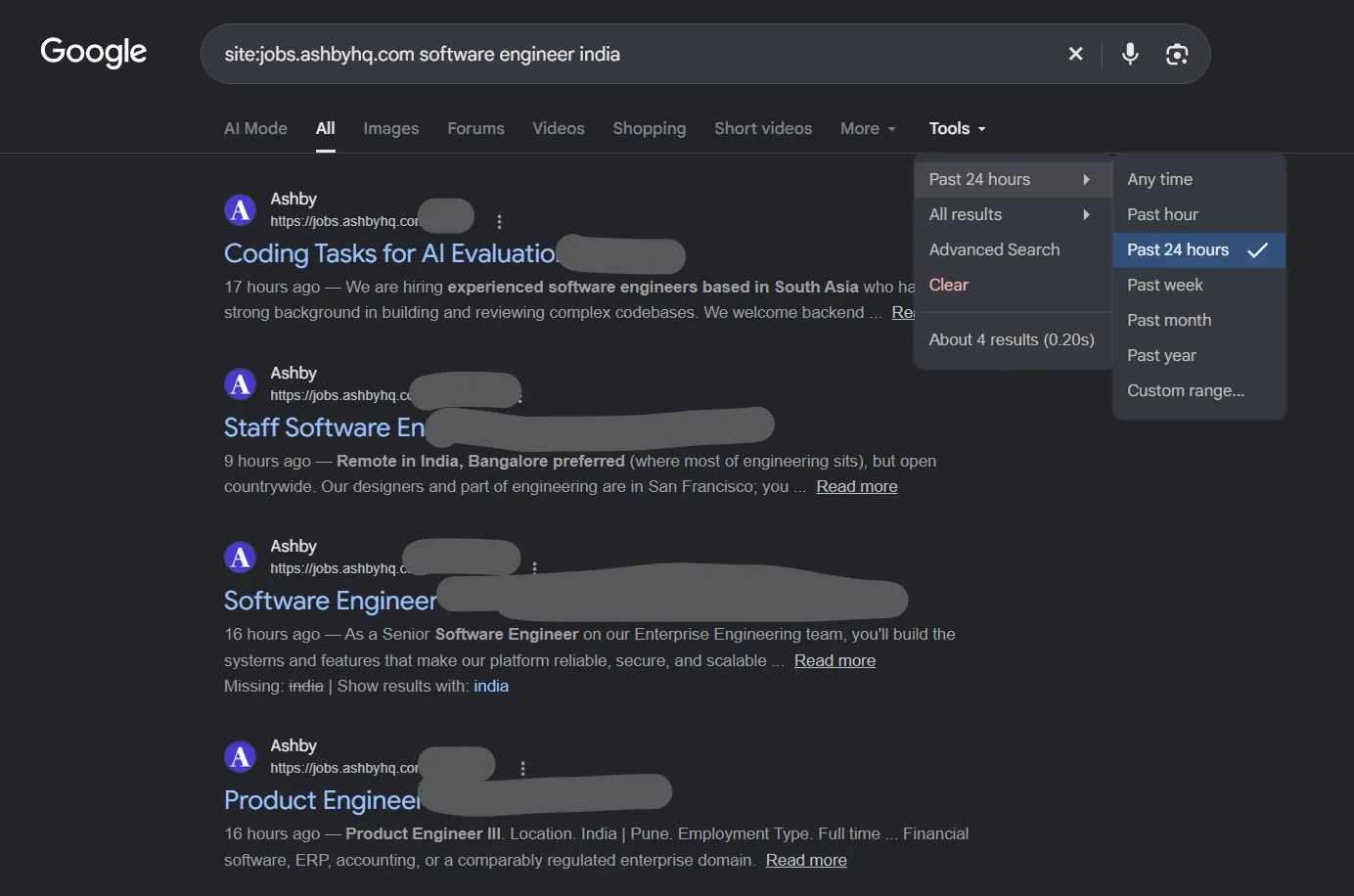
Heads up: a lot of the time you’ll find that most results are senior roles (Staff, Senior, Engineer III), even with -senior -lead. If you’re not at that level, skip them and keep scrolling.
How to make the LinkedIn algorithm send you jobs
LinkedIn’s feed works like Instagram or any other platform: it shows you more of whatever you interact with. So train it.
- Search posts, not just jobs. Use keywords like
software engineer hiring,backend engineer hiringorwe're hiring AI engineer, and switch the results to Posts. - Try hashtags too, like
#hiring, if they surface better posts for your role. - Interact with what you find. Like, comment, save, follow the people posting.
Do this consistently and within about a month your feed turns into a literal gold mine: posts with job links, Google Forms, referral links and “DM me your resume” threads, all fresh, all showing up on their own.
The catch: these posts move fast, so you kinda have to be chronically online. Check your feed often, because the early applicants on these posts are the ones who get noticed.
How I filter every job
Finding jobs is half of it. The other half is deciding which ones deserve your time.
Fresh jobs matter (a lot)
On LinkedIn, my rule became:
Prioritize jobs posted in the last 30 minutes.
I’d rather apply to something posted 20 minutes ago than to a role that’s been sitting there for four days with hundreds of applicants. The older a popular posting gets, the more competition piles up. The market’s already saturated enough. Don’t make it harder by living in stale postings.
Applicant count is a signal, not a rule
If you have LinkedIn Premium, you can often see how many people applied. If a relevant job has under 50 applicants, I’ll seriously consider it.
Not because 50 applicants means a guaranteed interview. It doesn’t. It just tells you how crowded that opening is right now.
But don’t see “20 applicants” and apply blindly. The job still has to fit your skills, your experience and your location, and be legit. It’s one signal, not the whole decision.
One more rule, and I stick to it: if a job sits on a portal with no captcha and an easy, agent friendly apply flow, assume it already has 1,000+ applicants, because AI agents can apply there nonstop. Skip it.
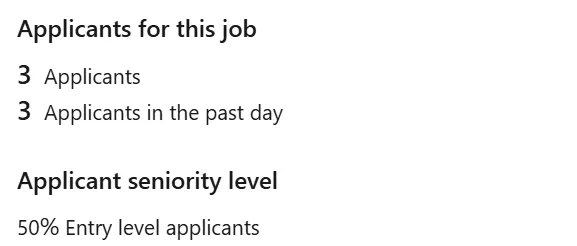
This is what you want to see: 3 applicants, all from today.
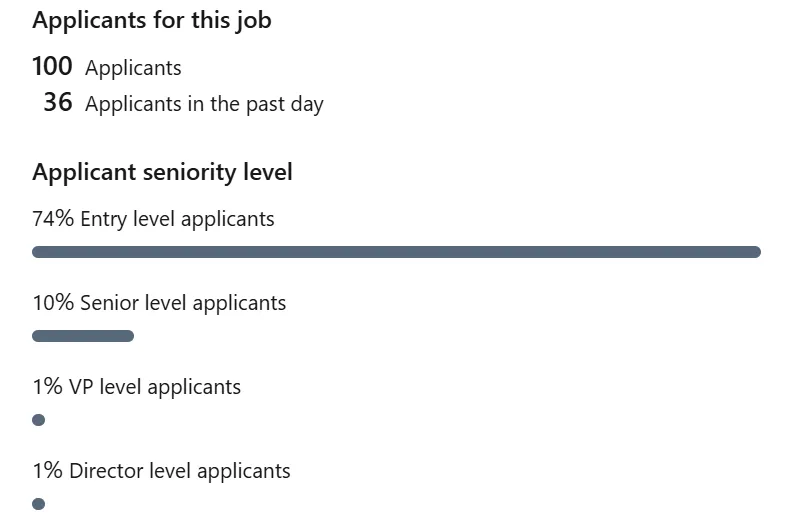
And this is a crowded one: 100 applicants, 36 of them today alone. The seniority breakdown is useful too: if most applicants are above your level, your odds drop even more.
Verify the company too
Ask yourself: who am I actually applying to?
Check their website, their LinkedIn page, whether they post, who works there, and whether the role actually exists anywhere else.
And don’t judge on vibes alone. “200 followers, must be sus” isn’t a real test. Tiny companies can have small pages and be totally legit. Big pages don’t automatically make a place right for you. Verify it yourself.
My filter, step by step
This is the exact order I run every LinkedIn job through:
- How long has the post been live? Fresh beats everything.
- How many applicants? Under 50 is where I want to be.
- Role alignment and company background. Do I fit the role, and does the company check out?
- Is it worth it? Every application is either a moonshot or a calculated apply. Know which one it is.
- Who’s hiring for this post? Look for the hiring managers or recruiters attached to it, if there are any.
- Apply, then DM or email those people.
- Follow up after a one day gap.
flowchart TB
    subgraph Filter
        direction LR
        A{Time live} -->|fresh| B{Applicants}
        B -->|under 50| C{Fit + company}
        C -->|yes| D{Worth it?}
    end
    subgraph Act
        direction LR
        E[Find managers] --> F[Apply + DM] --> G[Follow up day 2]
    end
    Filter -->|moonshot or calculated| Act
Fail any check? Skip it and move on.
The point isn’t to maximize applications. It’s to maximize the quality of the ones you spend time on.
How to tailor your resume (only when it’s worth it)
Make one resume per job title you’re going for. For example:
- Software Engineer
- Backend Engineer
- AI Engineer
Pick the closest one for each application. You don’t need to rewire your resume for every single JD. Only do it for the jobs that are worth it, the ones that made it through the filter above. For those, tailor it to the job description (JD). It takes less than 10 minutes. It’s honestly easy: paste the JD and your resume’s LaTeX source into Claude or ChatGPT, and ask it to work the JD’s keywords into your resume. Then read what it changed and make sure every line is still true.
(I’ll probably ship something totally free to make this even easier. Until then, that’s it. Use that.)
For a proper deep dive on resumes, check out the r/EngineeringResumes wiki.
What about AI agents that apply for you?
Okay, the spicy part.
There are now tools where AI agents search for jobs, match them to your profile, fill out the forms and hit submit. Tsenta is one example of a paid tool in this space. Not promoting it, just pointing out that the category exists.
I get why people use them. If you’re applying to hundreds of jobs, automation saves hours.
But zoom out. What happens when everyone does this? Applicants send AI-written applications, companies screen them with AI, and hiring turns into:
AI vs AI.
I don’t think that’s what recruitment should become. Hiring isn’t supposed to be a contest where the best bot wins. A company is hiring a human, and that human has to show they can do the work, understand what they’re applying for, communicate, and work with other people.
So I’m lowkey against fully automating it. AI as an assistant? Absolutely: searching, filtering, organizing, improving your resume, researching companies, prepping for interviews. AI as your whole job search? Nah.
Recruitment is still human first. That’s even more true for startups, small teams and founding roles, where knowing the right person can matter more than anything on your resume.
Which brings me to the part I’d repeat a hundred times.
Network. Network. Network.
DM people. Cold email founders. Talk to engineers, recruiters, hiring managers. Sometimes it works surprisingly well. Sometimes you get ghosted. Both are normal.
You’ll hear no for a lot of reasons: they aren’t hiring, the role isn’t open in your country, the budget isn’t there, or they just never reply. That’s fine. Other times you get a lead, an intro, a job, or you just meet someone interesting. All of those are wins.
A real example
Recently I got a lead from someone at Epic Games (not naming them). I was exploring compiler and programming-languages work, and was even open to an internship because I genuinely wanted to try that area.
From that conversation, I learned their hiring was focused on the UK, Europe and the US. So it didn’t turn into an opportunity for me.
Still worth it. Not every conversation needs to end in a job. Even finding out a door is closed is useful information, and the person is still in my network if things change later.
How to find the right person to network with
People tell me, “I want to network, but I don’t know who to talk to.”
It’s easier than you think. You don’t need a secret database. You need to find the actual team you want to work with.
Say you’re applying to Amazon. Don’t search “Amazon engineers.” Read the job description. It often names the org or team you’d join.
Say the role sits in org X and the team is team Y. That’s how my own Amazon team showed up too: a specific org, and a specific team inside it. So instead of messaging random Amazon employees, you’d search LinkedIn (or X) for team Y Amazon and find:
- managers and team leads
- engineers currently on the team
- people close to that org
Now your outreach is relevant. You’re not saying “hi, I want to work at Amazon.” You’re messaging someone who works on the exact team you want to join. Completely different starting point.
You don’t need a degree, a course or a paid tool for this:
- Read the job description.
- Figure out the team.
- Search for the team.
- Find people on it.
- Research them.
- Reach out.
That’s it.
Who to ask for a referral
My filter here is LinkedIn activity. People who post every day are less likely to refer you, and I think it’s because their DMs are already flooded. So look for people who are less active. Your message actually gets read there.
And if you find someone who can email the recruiter directly about you, that’s the biggest and best kind of referral there is.
Your opening message matters
I’m getting closer to what I think is the perfect first message, but I’m still experimenting. What I know so far: it has to be personal, specific, short, and written for that one person. They should immediately get why you’re messaging them, not the whole company.
For follow-ups, my rule right now is simple: wait one day, then follow up. How often after that, and how to keep it natural without making it feel transactional, is still something I’m figuring out. I’ll go deeper on this in Part 2.
Don’t only network when you need a job
Earlier, networking for me was about jobs, contracts and opportunities. Now I have a job and I’m still networking, just for different reasons: to meet interesting people, make friends, learn what other engineers are building, and build real relationships. My network is how I find out about new tech, how other teams work, and areas I didn’t know existed.
That’s what networking should be. Don’t make every interaction “can you refer me?”
Your network isn’t just your DMs
Your public presence is networking too. If you want people to know who you are, give them something to know you for.
What to post
Post things that are useful, genuine, worth discussing, and that you actually know or lived. Don’t post just for impressions. Don’t post generic AI takes because AI is trending. Don’t fake expertise.
I think about it as:
Value + Impressions
You need something worth saying, and it needs to reach people. The best technical post in the world does nothing for your network if nobody sees it. A million impressions on nothing useful doesn’t mean much either. You need both.
Not every post has to pop off
Some posts get 10 likes. That’s fine. Keep going.
After just a few weeks of posting useful stuff consistently, I started getting likes, comments and reposts from senior engineers I’d never met. That changes your network.
My feed changed too. It used to be mostly Indian engineers, Indian founders and Indian tech content. Now I see US and European founders, European recruiters, and engineers from all over. The point is:
Your network changes what you’re exposed to.
And when what you see changes, so do the opportunities, the conversations and the people around you.
Commenting is networking
The easiest way to start: comment on people’s posts. But if every comment is “Congratulations!” or “Great work!”, you’re giving nobody a reason to remember you. Those comments aren’t bad, they just don’t stick.
Add something. Make it specific and useful, both to the person who posted and to everyone reading the thread. This is how it compounds:
flowchart LR
    A[Comment] --> B[Noticed]
    B --> C[Profile visit]
    C --> D[See your work]
    D --> E[Familiar]
    E --> F[Easy convo]
Networking doesn’t always start with a DM.
You don’t have to yap
Some people have millions of followers because they’re great at talking. They post nonstop, have strong opinions, and yap. If that’s their strategy, cool. You don’t have to copy it.
You can grow by building things, sharing what you learn, helping people, and posting real experiences. And follower count isn’t the goal anyway. I’d rather have people who know what I work on, actually talk to me, and can introduce me to other interesting people. A network isn’t just a number.
Do you really need that paid course?
Hot take: not every course needs to be paid. Especially now, when AI makes information this easy to reach.
Want to learn AI stuff? There’s documentation, open source, research papers, tutorials, GitHub, and AI tools that can explain things to you. Don’t assume “I need to buy a course to learn this,” especially for a field that changes every month.
But access to information isn’t skill. You still have to study, build, break things, put in the hours and actually understand what you’re doing. AI makes learning easier. It doesn’t do the work for you.
Stay curious, then go deep
In AI especially, there’s always a new model, a new framework, a new agent tool, a new hype cycle. You don’t need to master all of it. Some of it fades in three months, and that’s fine. You just need to know what’s happening.
My loop:
flowchart LR
    A[Spot it] --> B[Understand]
    B --> C[Play]
    C --> D{Matters?}
    D -->|yes| E[Go deep]
    D -->|no| F[Move on]
The bigger principle: find something you can get unusually good at. Thousands of people are learning the same popular tools the same way. Just knowing the tool isn’t enough anymore. Build depth somewhere: a technical area, a niche in AI, infra, developer tooling, a domain, or a weird combo of skills. The area will change. The principle won’t.
There’s no shortcut. It’s going to suck sometimes.
This is probably the most important part, so I’ll be blunt: none of this is a shortcut. You still have to put in the hours.
It sucks when nobody replies. It sucks when applications get rejected. It sucks when you build something and nobody cares, or you don’t see results for weeks.
Keep going anyway. Apply today and hear nothing tomorrow? That doesn’t mean the strategy failed. You need enough reps to see the effect. Job hunting is a long game. Networking is an even longer one.
Final thought
I didn’t suddenly become a different engineer after application #300. I changed how I approached the market.
I stopped treating the job hunt as this:
flowchart LR
    A[Find job] --> B[Apply] --> A
and started treating it as this:
flowchart LR
    A[Find] --> B[Apply smart]
    B --> C[Find people]
    C --> D[Relationships]
    D --> E[Build in public]
    E --> F[Learn]
    F --> A
That’s a much bigger system, and I think it’s the part most people miss. The job market isn’t about hitting submit. It’s about knowing where to look, when to apply, who to talk to, what to say, what to build, what to learn, and how to keep going when nothing seems to work.
FAQ
How do I find fresh jobs before everyone else?
Search Google with site: queries on applicant tracking systems like Workday and Ashby, add -senior -lead to drop senior roles, filter to the past 24 hours, and on LinkedIn prioritize jobs posted in the last 30 minutes.
How many applicants is too many on LinkedIn?
I seriously consider jobs with under 50 applicants. If a job sits on a portal with no captcha and an easy apply flow, I assume it already has 1,000+ because of AI agents, and I skip it.
Should I use AI to apply to jobs for me?
Use AI as an assistant to search, filter, research and tailor your resume. Don’t fully automate applications. Recruitment is still human first.
Who should I ask for a referral?
Someone on the actual team you’re applying to, ideally a person who isn’t flooded with DMs. The best referral is someone who emails the recruiter about you directly.
How soon should I follow up after reaching out?
I follow up after a one day gap.
Coming up in Part 2
That’s Part 1. In Part 2, I’ll talk about remote jobs (where to find them and how to land them) and how to crack networking: the opening message, follow-ups, and turning cold DMs into real conversations.
Want in early?
I'm building something totally free to make job search easier for all of us. Drop your email and I'll tell you when it ships, plus new articles.
You're in! Thanks for confirming. I'll email you when the tool ships.
No spam. No AI slop. Just real stuff I build and write. Unsubscribe anytime.